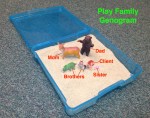
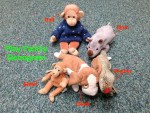
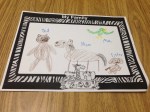
Play Family Genogram (Gil): Genograms can can provide insight into perceptions of relationships, dynamics, support systems, etc. Utilizing play or art let’s one visualize and organize their family structure and makes the process more engaging and developmentally appropriate.
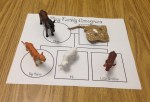
- Toys: My favorite way to do this is by providing assorted animals (plastic miniatures or stuffed toys) for them to choose from. You can draw out a traditional genogram to place the animals on or simply arrange them on a table or in a sand tray.
- Art: An alternative is to have them draw the animals they have chosen for their family members. Click here for a simple worksheet titled “My Family Zoo.”
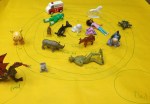
- Non-Traditional Genogram: The confines of a traditional genogram do not work for everyone (ex. many foster youth) so it is important to modify the activity accordingly. For my favorite version I get a large piece of paper and draw concentric circles. The animals are placed in various circles, organized by closeness to the child and may be a mix of biological and non-biological relatives and friends.
- Genogram Instructions: Start by giving directions like “If your family were animals, which ones would they be?” or “Choose a figure to represent each member of your family” or “Show me which animals are most like your family members? or “Find animals that best show your thoughts and feelings about your family”
- Discussing the Genogram: Use the genogram to have a discussion about family. Talking about the family in terms of the animals chosen, rather than the family member (ex. “the big bear,” rather than “your dad”), may make children feel more comfortable discussing difficult topics. Examples are “I’m wondering how the dog and the bear get along” or “What would the puppy say to the bear if it could talk?” or “What is it like for the puppy to ___?” or “What is the cow doing/thinking/feeling/hoping for/etc.?” Do not ask why they chose each animal.
- This activity can easily be expanded to meet specific needs. An example of another activity would be to ask the child to choose another figure to go with each family member that shows how they feel about that person. You can also direct them to create a family scene in the sand tray from here.
- Important Note: Do not read too much into the characters chosen or use this activity to make sweeping interpretations. If something stands out to you, state what you notice and see how the person responds (ex. “I notice that the bear is *insert observation (not interpretation*). I’m wondering what he is thinking,” rather than “he looks angry/scary”).
- *Examples are not client work and do not represent real families*
 Nurse The Soul